
TL;DR
The yoga poses most likely to support a painful or unstable back are often the quietest ones: positions that build intra-abdominal pressure, coordinate breathing with trunk control, and teach your spine, pelvis, and hips to work together. Flashy flexibility work feels productive but frequently misses what a struggling back actually needs. Starting with stability, not range of motion, gives your body a stronger foundation to build from.
────────────────────────────────────────────────────
Most people reach for the wrong tool first
When your back feels stiff or sore after a long shift, a training session, or a weekend of yard work, the instinct is to stretch it out. You open YouTube, search for yoga for back pain, and find yourself attempting deep forward folds, dramatic spinal twists, or full backbends. It looks like progress. It feels like something is happening. But for a lot of people in that situation, it does more to irritate the back than settle it.
The poses that tend to support a sore or unstable back are rarely the ones that photograph well. They involve controlled breathing, modest ranges of motion, and positions that quietly challenge your trunk to hold itself together. That is the angle worth understanding before you roll out a mat and start forcing your spine into shapes.
This post covers why stability matters more than flexibility in most back pain situations, which types of poses support that stability, how to read your body’s response, and when to get a clinical assessment before pushing further.
Why impressive-looking yoga poses are not always the goal
Back comfort depends on more than how far your spine bends. It depends on how well your spine, pelvis, ribs, and hips share load during movement. Research on spinal posture and low back pain reinforces that how the spine is positioned and loaded during activity matters significantly for symptom behaviour.
Deep forward folds, aggressive twists, and large backbends place the spine at or near end range. When symptoms are active, those positions can add load to structures that are already irritated. The movement feels like a release, but the back responds the next morning with more guarding, more stiffness, or more soreness.
Yoga poses for back pain should be selected for how they support your movement, not how advanced they look. Slow tempo, steady breathing, and careful positioning create real work without requiring big ranges of motion. The less visible the effort, the more the body often benefits from it.
What does a stability-first approach actually mean?
Structural stability, in simple terms, means your spine, pelvis, ribs, and hips work together to manage load without one area compensating too much for another. Stabilizing yoga poses for back pain tend to use smaller ranges of motion, longer holds, and deliberate breathing patterns because those elements challenge the trunk to stay organized under mild demand.
One concept worth understanding here is intra-abdominal pressure. When you breathe and engage your core together, the muscles around your abdomen and lower back form a kind of pressurized cylinder. That cylinder supports the spine from the inside out. Certain yoga positions, particularly those that involve grounded breathing and mild core contraction, encourage this response naturally. This is a central principle in core stability training and one reason why some quieter poses are more useful for back pain than their appearance suggests.
Stability does not mean stiffness. It means controlled movement with options. A stable back is one that moves well, loads predictably, and does not collapse or guard under normal demands like sitting at a desk, lifting groceries, shovelling a driveway, or returning to sport after time off.
Which yoga poses support back stability?
The following are gentle examples worth considering. They are not a prescription. If you are managing active symptoms, moderate these to your current tolerance and speak with a clinician before progressing.
Constructive rest breathing
Lie on your back with knees bent and feet flat. Allow your lower back to settle toward the floor without forcing it. Focus on breathing slowly, feeling your ribs expand side to side. This position reduces guarding, improves awareness of rib and pelvic position, and helps the trunk muscles engage more naturally with breath.
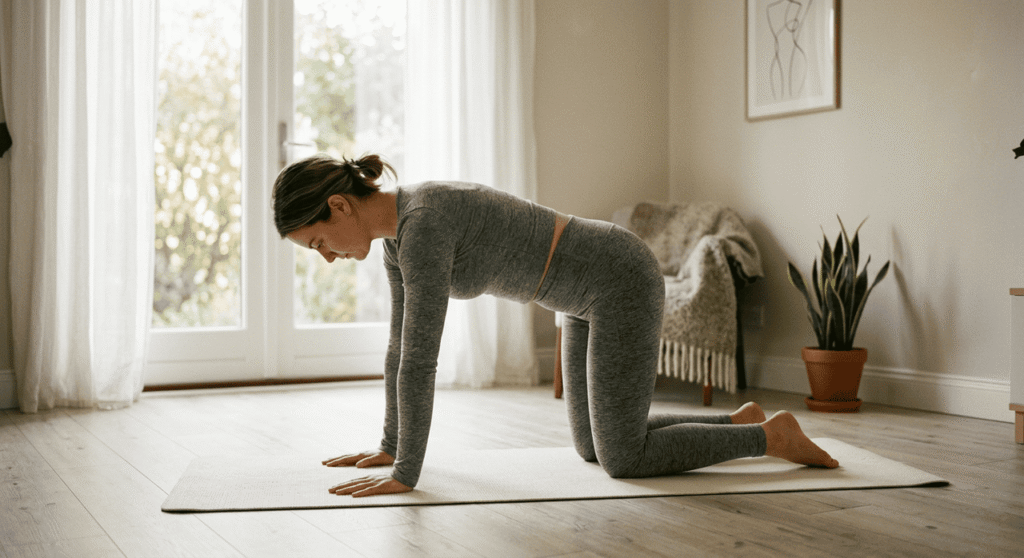
Cat-cow in a small range
On all fours, move gently between a slight arch and a slight rounding of the spine. Keep the range small and controlled. The goal is comfortable, rhythmic motion, not a dramatic stretch at either end. This encourages spinal mobility without loading end range.
Happy baby pose
This one looks simple and is often underestimated. Lying on your back, you draw both knees toward your chest and hold the outer edges of your feet. The position encourages natural posterior pelvic tilt, mild hip opening, and a grounded breathing pattern that supports core engagement. Several elements of this pose align with Dynamic Neuromuscular Stabilization (DNS) principles, a clinical framework focused on how the core activates during postural control. It is one of those poses that looks like rest but asks quite a bit of the body when done with attention to breath and position.
Bird dog variations
From an all-fours position, extend one arm and the opposite leg while keeping the spine stable. The trunk works to resist rotation and extension without the spine moving significantly. This is a practical core stability exercise that fits naturally into both yoga and rehab programming.
Supported bridge
Lying on your back with knees bent, press through your feet and lift your hips slightly. Engage your glutes and keep your spine in a neutral position. This builds hip and glute strength in a grounded, controlled way without loading the lumbar spine heavily.
Side plank from knees
A scaled version of side plank that builds lateral core strength. The knees-down variation reduces demand on the shoulder and hip while still challenging the trunk to resist side-bending. This kind of lateral stability work is often missing from both yoga practice and general exercise routines.
Gentle yoga for lower back pain should feel controlled and manageable. None of these positions should produce sharp, shooting, or spreading sensations. If symptoms worsen, spread into the leg, or feel unusual, stop and seek clinical guidance before continuing.
How do you know if a yoga pose is helping or overloading your back?
Not every uncomfortable sensation means a pose is harmful, but not every sensation that feels like a stretch means the movement is productive either. Here is a practical way to monitor your response:
| Timeframe | What to notice | What it might suggest |
|---|---|---|
| During the pose | Mild effort or stretch sensation | Generally within reasonable tolerance |
| During the pose | Sharp, shooting, or spreading symptoms | Reduce range or stop; seek guidance if it persists |
| 30 minutes after | Back feels steadier or less guarded | Positive response worth noting |
| 30 minutes after | Increased soreness or stiffness | Pose or load may need to be modified |
| Next morning | Movement feels more confident | The approach is likely appropriate for your current stage |
| Next morning | More guarding or pain than before | Reassess the selection and consider a clinical review |
A simple working rule: choose poses that leave you feeling steadier, not more guarded. Every back responds differently, and what works well at one stage of recovery may need to change as strength and tolerance build.
Where does core stability fit alongside yoga?
Yoga and rehab-style strength work overlap more than most people expect when both are focused on controlled breathing, spinal position, hip strength, and gradual progression. Research exploring yoga’s therapeutic effects supports its role in improving quality of life and physical function, particularly when the practice is adapted to individual needs.
Core stability is not about crunches. It includes resisting rotation, controlling the pelvis under load, coordinating breath with movement, and building tolerance across a range of positions and demands. If you want a deeper look at what that actually involves, the guide to physiotherapy for back pain covers how clinical assessment shapes this process.
Yoga is one useful tool within a broader movement plan. It is not a standalone answer for every type of back pain, and it works best when the poses selected match the individual’s current strength, mobility, work demands, and goals. A physiotherapy assessment helps clarify which pieces are missing and how to sequence them.
When should you get guidance before pushing further?
Consider booking an assessment if your back pain keeps returning after short breaks, limits your training or work performance, comes with nerve-like symptoms such as numbness or tingling into the leg, or makes daily movement feel unpredictable from day to day.
Sudden severe symptoms, unexplained weakness, loss of feeling in the groin or inner thigh, changes in bladder or bowel control, fever alongside back pain, or pain following significant trauma should be assessed promptly by a qualified health professional. These are not situations to manage with yoga modifications.
For most active people in Transcona and across Winnipeg, the question is not whether to keep moving. It is how to move in a way that supports recovery rather than working against it. A measured, individualized plan makes that process more straightforward. As MedlinePlus notes in their guide to posture, how you carry and control your body during daily activity plays a meaningful role in how your spine manages load over time.
Key Takeaways
• Stability-focused yoga poses for back pain tend to be more useful than deep stretches or large ranges of motion when symptoms are active.
• Intra-abdominal pressure, created by combining breathing with core engagement, supports the spine from the inside out. Certain yoga positions encourage this naturally.
• Poses like constructive rest breathing, bird dog, supported bridge, and happy baby build trunk control without requiring advanced flexibility.
• Monitor your body’s response during, 30 minutes after, and the morning after any new pose. Improved steadiness is a positive sign; increased guarding or spreading symptoms are signals to modify or seek guidance.
• Yoga is one part of a broader movement plan. Core stability exercises for back pain, load management, and strength training often need to be part of the picture as well.
• Sudden severe symptoms, neurological changes, or pain following trauma require prompt clinical assessment, not self-directed yoga practice.
Ready to build a plan that fits your back and your goals?
If back pain keeps interrupting your workouts, your work, or the activities you do every day, a physiotherapy assessment gives you a clearer picture of what is actually happening and what to do about it. At Harbourview Therapy, we assess how your spine, hips, core, and movement patterns are working together, then build a personalized plan around your specific goals, whether that is returning to training, managing a physical job, or moving through daily life with more confidence and less second-guessing.
The focus is steady, measurable progress: moving better, building strength, and returning to the activities that matter to you.
Frequently Asked Questions
Are gentle yoga poses enough for lower back pain?
Gentle yoga supports mobility, breathing, and body awareness, but many people also need progressive strength work, load management, or a structured exercise plan alongside it. If symptoms keep returning after periods of yoga practice, an assessment with a physiotherapist can help identify what else needs attention.
Should I stretch my back if it feels tight?
Tightness does not always mean the tissue needs stretching. It sometimes reflects guarding, fatigue, or reduced motor control rather than actual tissue shortness. Stability-focused poses are often a more productive starting point than deep stretching, particularly when the tightness comes and goes or worsens with activity.
What should I avoid if yoga makes my back pain worse?
Avoid forcing deep forward bends, end-range twists, or prolonged holds if they increase or spread your symptoms. Use props, reduce your range of motion, slow your pace, and pay attention to how your back responds in the hours after practice. If discomfort persists, changes character, or spreads into your leg, seek clinical input before continuing.


